

Showing posts with label 4 Nicaragua. Show all posts
Showing posts with label 4 Nicaragua. Show all posts
Monday, the 20th and Tuesday, the 21st of October

Saturday, the 18th and Sunday, the 19th of October
 |
| Brother Phap Lieu holding the bell |
Cantera is a
very green, beautiful Catholic seminar center located just outside of Managua.
Saturday at 9am we begin with a peaceful walking meditation which allows the 95
participants to dive directly into the energy of mindfulness and the gift of
being part of a harmonious community. Softly we touch Mother Earth, receive
Father Sun’s warm embrace, and rejoice at the sight of generous orange trees,
coconuts, sacuanjoches (plumeria), monjes (“monks”), blue water lilies... an
hour of this regenerating silence later, we are in the Dharma hall to deepen
the most basic practices with Brother Phap Lieu and Brother Phap The: Meditation
and full awareness are not just for the periods we are on the meditation
cushion. We apply them also while walking, standing, and lying down.
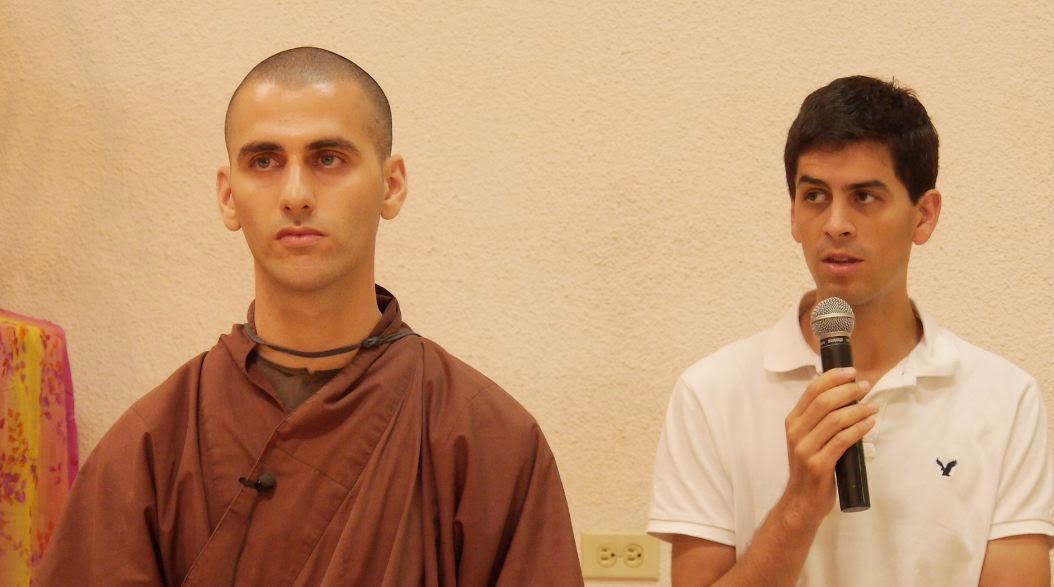 |
| Brother Phap The and Joaquin, during orientation |
Every time
you can, remember to enjoy following your breath and allow your whole being to
smile. If your practice of meditation makes you struggle and suffer more, it
means it’s not a correct practice! The energy of mindfulness of your breathing,
steps, and so on, makes you grounded and centered on your vertical axis, and
you then become able to embrace your loved ones and all beings around you,
opening a horizontal axis. You develop the 5 powers of faith, diligence, mindfulness,
concentration and wisdom.
 |
| young Nicaraguan friends sitting in peace |
 |
| Wouter, the film maker of the tour |
At noon,
Brother Phap Khai guides the eating meditation. People report that they are so
impressed and inspired to see that it’s possible to remain patient and keep a
bright, compassionate smile like that of our Brother! They also like to put
down the fork while chewing the bite of the present moment, instead of rushing
to prepare the following spoonful of food. Aurora continues to be the champion
of deep relaxations, while Wouter is unsurpassable at mindful filming and photo-taking
(even the wildest Sisters have quit being camera-shy a long time ago).
Something
especially great in this retreat is that it is attended mostly by social
workers and activists, young people who protect women against domestic
violence, help street children, women who’ve set up an agricultural
cooperative, and a lot of Laura’s friends from Pronica (see www.pronica.org).
Among the 2 Wake Up groups, there are also teenagers and young adults who’ve
been supported by these volunteers. They are so brave and to hear them tell
their life stories, talk about their happiness in this retreat, to see them
firmly attentive during the Dharma talks and dharma sharings is something
unforgettable.
Sunday
morning, Sister Su Nghiem offers a very nourishing guided meditation in
spanish. ‘Breathing in, I feel calm. Breathing out, I feel ease and solidity.
 |
| Laura enjoying the 2nd mindful movement |
Brother Phap Luu opens the Dharma talk with a wonderful poem by Ruben Dario,
the most famous Nicaraguan poet (Hemos de
ser justos). He builds bridges between the Christian faith in the Holy
Spirit and the faculty each of us has to generate mindfulness. We let the
Divine enter us with our in-breath and out-breath. We have the power to put our
attention there instead of giving it to unwholesome objects like violence and wrong
desire. Our Brother also teaches about true love and the four Immeasurable
Minds. Sister Boi Nghiem explains how to begin anew and reconcile in the
family. There are four steps, the first is called watering flowers. You may
want to thank someone and say: ‘the way you looked at me this morning reminded
me that life is beautiful.’ The second step consists in recognizing your own
shortcomings and expressing regrets. We grow both our courage and humility by
pronuncing the sentence: ‘I’m sorry for having said/done such a thing. I don’t
want to repeat that mistake. Please forgive me.’ The third step is taken if we
are feeling hurt by someone, we also put our pride aside to reveal that ‘I am
suffering. I don’t understand why you said/did this and I need your help.’ Finally,
the fourth step is to ask for help when you are going through a personal
difficulty, or if you know you have a weakness and you would like your loved
one to support your transformation. For example your may say: ‘Since my
childhood I have the strong habit of reacting in discussions, could you breathe
with you when I’m pushed by that habit?’
 |
| Sister Boi Nghiem and the 3rd mindful movement |
The closing
of the retreat is marked by the symbolic planting of a guava tree in Cantera,
which will grow along with 500 fruit trees that our delegation offered to the
women’s cooperative in Rio Blanco, a token of compassion for future generations
as well as a significant action to offset the carbon emissions due to our
flights across the continents.
Friday, the 17th of October
In the morning, at Quaker House, Joe Connolly gives us a
very informative historical background of Nicaragua, in which we learn how
Spanish imperialism as well as US interventions in the local government have
rather sadly marked the development of the country. Still today with the
beginning of democracy, the majority of the people cannot meet their daily
material needs. But at the same time it is said that Nicaraguans know how to
enjoy life because of their awareness of impermanence and of what is essential.

At midday we cross a part of Managua to go to cultural center Hispamer, to share an afternoon of mindfulness for about 80 people of all ages; upon arriving we are welcomed by a crew of young people joyfully and wholeheartdely involved in organising the event.

 |
| tangerine meditation |
The event ends with powerful and
grounded questions from the audience, about the pratice of deep listening,
slowing down at work and especially handling situation of violence with the
pratice of mindfulness ; all these questions reveal the tonality of this
day which has been for all of us a great opportunity to discover more deeply
Nicaraguan social issues and the people's main concerns.
Thursday, the 16th of October
 |
| land of lakes and volcanos, Nicaragua here we come! |
“Fasten your
seatbelt” (of mindfulness!) We land in Managua to meet with Laura, Milton and other friends who drive us to the Quaker house (Casa de los Amigos) where we’ll be staying. On the way, we are told that Nicaragua is the second poorest country of Latin America. We can witness to many people in the streets, including children, trying to make a living by selling flowers, fruits, washing car glass or doing other small jobs.
Not long after we arrive to the cosy Quaker house, it’s already time for three of us to pay a most friendly visit to some 60 teenagers in Casa Allianza. They are young people coming from very vulnerable backgrounds and situations of risk, living in the streets, victims of domestic violence, sexual abuse, exposed to drugs... In this residence, they are safe and lovelingly cared for by a team of real Bodhisattvas.
 |
| what are they doing??! |
In the evening,
we are at the Allianza Francesa for three hours of teachings and practices on
the themes of happiness and freedom.

 |
| recognizing and writing today's moments of happiness |
There are a lot of young people in the audience. Very soon
the atmosphere becomes peaceful and grounded. “Breathing in, I feel my whole
body. Breathing out, I smile with tenderness to my body.”
In every moment, it’s
possible to generate a feeling of happiness by recognizing the good conditions,
the wonders of life that are still available to us. Just looking at your day
today, can you name five moments of well-being, of contentment, of joy?
To be
truly free, we should train ourselves to release regrets that bind us to the
pain of the past and anxious thoughts regarding the future.
Subscribe to:
Posts (Atom)